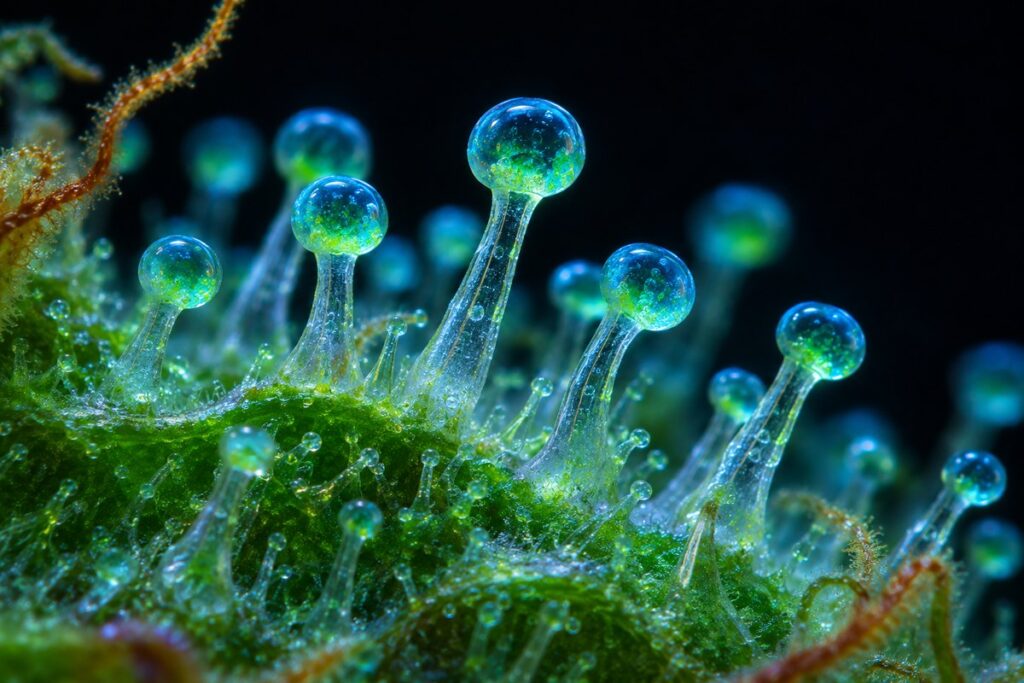
A cannabis flower under a fluorescence microscope can look as though someone has switched on dozens of little lamps. Each lamp sits at the tip of a hairlike structure called a trichome. In some of the most revealing images, the tips take on quite different colors. A pale blue gland and a neighboring gland with a reddish cast raise an appealing possibility. Could a botanist read the chemistry of a flower from a photograph?
There is a surprising amount to read, starting with the shape of the lamp itself. In a study of developing cannabis flowers, Samuel Livingston and colleagues examined glands at several stages of growth. They also examined glands on leaves. Seen from the side, some rose on conspicuous stalks. Others sat so close to the plant surface that a stalk was hard to distinguish. Seen from above, each rounded head concealed a small piece of organized anatomy.
What lies beneath the bright dome
A ring of secretory cells forms a disc near the base of the head. Above it lies a cavity, bounded on the outside by the plant’s cuticle. Material made by the cells collects in that space. A light microscope can therefore show two different things in the same small field: the cells that make a secretion and the reservoir where their products accumulate. The bright tip belongs to a structure with an inside.
Fluorescence occurs when a substance absorbs light and emits some of the energy at another wavelength. Here the researchers took advantage of material that did this naturally, without adding a fluorescent dye. Detectors collected the emitted light in different wavelength bands. The colors in a published image convey how the microscope divided and displayed that light. A guide to quantitative fluorescence microscopy explains how the settings used to record an image affect the intensities a scientist can compare. A blue tip in a figure need not look blue to someone holding the flower in daylight.
Eight cells gave the investigators a clue
In the leaf glands classed as sessile, meaning seated directly on the surface, the team consistently counted eight cells in the secretory disc. The mature stalked glands on flowers had more than eight. The contents of the leaf glands emitted light shifted toward the red end of the range examined. The stalked floral glands showed a shift toward blue. Shape, cell count and emitted light gave the researchers three ways to compare the same structures.
The interesting specimens were on young flowers. Some glands looked squat enough to pass for the sessile glands of a leaf. Yet their cell counts and fluorescence suggested a different identity. Together with observations across flower development, those clues supported the idea that many of the short floral glands were on their way to becoming stalked ones. A single photograph taken too early could put two biologically different glands in the same category.
Where the photograph runs out of answers
Chemical measurements brought another distinction into view. The mature stalked glands had secretions rich in cannabinoids, and their terpene profiles favored monoterpenes. The leaf glands had a higher proportion of sesquiterpenes. These are families of compounds. More than one substance can contribute light in a given band, and brightness also depends on the specimen and the instrument. Converting one bright pixel into a percentage of THC would require evidence quite different from this comparison.
Other microscopes make different bargains. In a study of preserving glands for electron microscopy, researchers tackled a practical difficulty: preparing lipid-rich tissue without losing the structures they wanted to see. A computer-assisted study of gland counts faced another question about images, how reliably to distinguish individual glands across a crowded surface. Preservation, counting and chemical identification each demand their own checks. What the glowing tip did exceptionally well was point out a developmental difference that a botanist looking only at stalk height could easily miss.